Notes on Henry Kissinger by Paul A. Myers
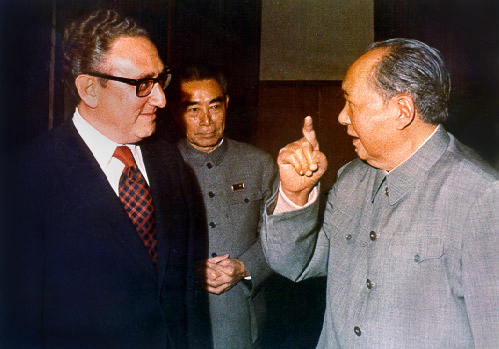
Henry Kissinger died November 29, 2023 at age 100 ending a century during which the United States rose to superpower preeminence with Kissinger as one of its most prominent statesman, a leading foreign policy thinker during an era when America was ascendant if not exceptional. Nevertheless, well developed assessments of Kissinger’s career are mixed and run the gamut from war criminal to master strategist all the while admitting to the man’s genius. The assessments are controversial and contradictory just as is the contested field of international relations in a conflict-ridden time. The upheaval of conflicting human passions on the increasingly crowded global stage creates a cacophony of forces defying unified explanations—in both theory and practice.
Kissinger’s thinking is built around a deep and far-reaching understanding of real politik which stands in contrast to the more idealistic framework held by much of the foreign policy elite, itself centered on idealistic exceptionalism (and reflecting this elite’s view of itself). Since the country’s founding, the elite view of America’s role in the world has been that American policy is distinctly superior to that of other countries because its exceptionalism derives from ideals expressed in its founding documents. These ideals have powered an upward continual arc of aspiration to the current level of high concern with global human rights and democracy. In contrast to this high road of aspiration, Kissinger has been seen by many as a proponent for expanding the reach of an amoral, regime-change-scheming American state so obsessed with its own security that it makes excessive use of unconstrained military and intelligence power. The institutional accountability committees in Congress, generally weak sisters among the inside-the-beltway power players, have never been able to put the CIA under supervisory restraint and keep it there. In sum, Kissinger’s take-the-low-road approach to great power management disturbs many thoughtful, well-meaning Americans. This is American exceptionalism?
Kissinger is a celebrated thinker on great power relations and his mastery of this field undergirds his greatest success as a practicing statesman, which was not having a nuclear war with the Soviet Union during his tenure. He achieved this goal by developing a framework resulting in enduring reductions of dangerous tensions between the US and the Soviet Union through a series of arms control agreements, often bitterly assailed by intractable far-right ideologues on the Republican paleoconservative right. Many contemporary assessments fail to take full cognizance of this dog that never barked. The threat of nuclear war was omnipresent during the volatile Nixon presidency. Kissinger kept the Cold War cold during a period of maximum tensions. President Richard Nixon was a mercurial person who was a study in the intersection of politics and paranoia, a driven presence who stalked the White House corridors in the night talking to the portraits. One should not underestimate that the Larger Peace was well kept during Kissinger’s tenure; he wrote a book off his doctoral dissertation on the post-Napoleonic conferences that laid the groundwork for the Long Peace that lasted until the First World War. In this view, peace is an uncertain equilibrium between great power conflicts caused by the balance of power going askew.
Kissinger’s career should be understood as consisting of two phases with different layers in each phase. One phase was the years in power 1969-77 as national security adviser and then secretary of state. The other phase was his post-power years as a writer, thinker, and head of his highly influential consulting firm where he met and interacted frequently with top leaders of all stripes around the world. Ideas have reach and impact in foreign affairs. Considering the oft-ineffectiveness of American military interventions, ideas are an often-too-little-used item in the American foreign policy toolkit. Kissinger’s career reminds us that thinking beats non-thinking, the typical bureaucratic product of Washington groupthink which compromises itself to comfortable ineffectiveness.
The years in power are salient because how a person uses power reveals much about character. In Kissinger’s case, the eight years in power were multilayered and some of those layers have some dark chapters indeed. Some of the darkness may be attributed to his patron, President Nixon, the dark prince of American presidents and an inveterate schemer.
Nixon narrowly won the election in 1968 with the public seemingly desiring a winding down and termination of the Vietnam war. There were 28,000 dead American servicemen by early 1969; the final toll six years later was 58,000 dead Americans and hundreds of thousands of dead Asians followed by millions more in the post-American-withdrawal genocides. The Nixon-Kissinger regime was a ghastly failure on the most important metric of all—human lives. The Nixon-Kissinger duo seem to have expanded upon the mistakes of the administration of President Lyndon Johnson, not rectified them. This record also set a template for future American military interventions where failed basic mission accomplishment accompanies massive collateral deaths of innocent civilian populations. Increasingly over time negative worldwide public opinion is moving against aerial bombardment and its inevitable collateral damage to civilian populations. Bottomline for Vietnam – the Nixon-Kissinger led expansion of the war into Cambodia and Laos may have inevitably led to subsequent total defeat in South Vietnam rather than some less ghastly negotiated solution years earlier. The Nixon-Kissinger duo kicked the Vietnam can down the road and through the graveyards of Southeast Asia to pickup short-term US domestic political support. That the negative consequences flowing from the 1975 defeat were not even more consequential to America just confirms that Vietnam was the wrong war at the wrong place at the wrong time—with probably the wrong team at the top.
With the immolation of Indochina continuing, Kissinger supported a second fiasco in what was then called East Pakistan and is now Bangladesh and where a policy that utterly failed again resulted in hundreds of thousands of deaths when Kissinger engineered support for a corrupt and murderous Pakistani regime. The Nixon-Kissinger duo owns all 100 percent of this fiasco.
Another notable initiative was using the CIA to foment and assist in a coup that overthrew Chile’s democratically elected President Allende and established a military junta regime. This followed Republican regime change coups in Iran in 1953 that brought the shah to power and in Guatemala and set the stage for disastrous Reagan-era initiatives in Central America which fostered the mindsets leading to the massive nation-building failures in Iraq and Afghanistan. That regime change seems to continue to be an evergreen go-to page in the Republican party playbook suggests a party of recalcitrant slow learners, witness Trump national security adviser John Bolton and his consistent cheerleading for regime change of intractable adversaries and institutional decapitation for multilateral bodies.
The Big Enchilada in the Nixon-Kissinger years was the strategic opening to China which further separated the two big Eurasian communist powers from one another. The two men celebrated this for years as the greatest diplomatic triumph of the era. The hope was that such division would help bring North Vietnam around to making a favorable negotiated peace while creating an overall new balance of power between the three large countries favorable to America.
The price of such a deal was a double-cross, something of a Nixon political specialty. Nixon had long been supported politically by Nationalist China’s Chiang Kai-Shek and his government in exile on Taiwan. Chiang’s politically astute wife Madame Chiang was the brains behind the potent lobbying operations organized into the informal China Lobby, one of whose biggest beneficiaries was Richard Nixon. Madame Chiang’s deputy dragon lady was Madame Chennault (the beautiful young Chinese woman Madame Chiang placed in Flying Tiger general Claire Chennault’s marital bed during World War II) who was the go-between in 1968 that carried messages from Nixon’s entourage to South Vietnamese president Thieu that led to deadlocked peace talks in Paris as the South Vietnamese balked at concessions pushed by American negotiators. The crux of the deal was that Thieu would get a better deal under a Nixon administration. Nixon’s hardline reputation gave this argument some credibility.
Chairman Mao and Prime Minister Chou En-Lai saw Nixon and Kissinger coming and knew that the two Americans could be played. The Americans needed the deal more than they did. And played they were. Kissinger, during the arduous negotiations leading to the Shanghai Communiqué, conceded away the sovereignty of the government on Taiwan with the adoption of the One China Policy. This sellout consigned Taiwan to decades of diplomatic limbo. It was sort of like British Prime Minister Chamberlain and French Premier Daladier giving away Czechoslovakia to Hitler when Czechoslovakia had not even been in the room when it too was sold out that fateful night in Munich in 1938. One wonders just what Mesdames Chiang and Chennault thought about being sold out by Nixon on China. Was Madame Chiang surprised?
What is the legacy of the One China policy? Kissinger’s role is ultimately going to be judged by this still unresolved conundrum from the 1970s. Will Taiwan stay independent and autonomous? Or will it go under and become a second Hong Kong, a stunted appendage to an autocratic Beijing dynasty? If Taiwan goes down, will that be seen as the consequence of a late night sellout from over a half century ago?
Kissinger’s other area of lasting impact was in the Middle East where his shuttle diplomacy between Israel and various Arab capitals during and after the 1973 Yom Kippur war resulted in a peace that brought a certain stability to the region for two or three decades. The most durable outcome of this process was the 1978 peace between Israel and Egypt arranged by the Carter administration. One view is that Egypt wanted to get out of the Middle East and return to its geographical status as a North African country with the Sinai Peninsula serving as a geographical wall blocking out the endless problems emanating out from the Middle East. This also explains why Egypt resolutely refuses to let the Palestinians emigrate out of Gaza into Egypt in subsequent conflicts. Gaza is a very hard border with many dimensions to the Egyptians; they don’t want to import Palestinian discontent into a volatile and rapidly expanding Egyptian population straining at its resource limits. Would a Palestinian exodus be a blasting cap?
The stability between Israel and its other Arab neighbors gained by Kissinger has been a cold peace broken up by intermittent bouts of horrific violence. One recent observer noted that Kissinger concluded in the 1970s that Israeli irredentist interests in keeping some or all of the occupied territories from the 1967 war would be a force to try to maintain a status quo condition in permanent tension with the Arab countries’ continued dissatisfaction with the 1948 establishment of Israel, which created the destabilizing Palestinian diaspora. Much of the Muslim world views the European war leading to the establishment of Israel as a clash between European colonial and imperial powers that did not involve them but nevertheless resulted in a new state populated mostly by former European refugees on what the Muslims view as their ancestral lands. The resulting resentments against the West are deep-seated and long lasting, not untypical of irredentist situations.
Three Notable Kissinger Books
Looking at Kissinger’s legacy, three notable books from Kissinger’s extensive oeuvre are World Order, Diplomacy, and A World Restored: Metternich, Castlereagh and the Problems of Peace 1812-1822. One starts with World Order where Kissinger in one of the central chapters assesses the origins and characteristics of the Muslim world and contrasts these with the European world, which is just one of the power relationships explored in this multifaceted tome. One takeaway relevant to today’s controversies over immigration is that, at best, successful assimilation of large numbers of Muslim immigrants into the European political culture will be a rocky, trouble-strewn project. There is a fundamental divergence of world views between European an Muslim communities. The coming decades will be a testing time.
Internationally, a central question for the western community, where geopolitical stability is central to the growth of prosperity, is how can a future rapport be established with the Muslim world? One then moves on to read Diplomacy since it covers the tools of real politik developed by Cardinal de Richelieu, the archetype of the modern European statesman, during the Thirty Years War. How real politik works in practice is laid out in A World Restored where Kissinger the contemporary foreign policy genius explains the intricate machinations of the preceding century’s foreign policy genius, the Austrian statesman Klemens von Metternich. The tools first developed by Richelieu were used two centuries later by Prince Metternich at the 1815 Congress of Vienna to craft the framework for the long peace—an absence of an all-European-wide war—that covered the nineteenth century and was only ended by the cataclysm of the First World War (there are those that feel this assertion claims too much for the long peace). Implicit in this understanding of world affairs is Kissinger’s mastery of the principles of European philosophy to illustrate principles abstracted from the two statesmen’s subtle maneuvering through complex affairs; this is anything but an all-out application of pragmatism. Today’s European Union embodies many of the principles of constructing and maintaining a balance of power through international politics, a process developed by hard experience over recent centuries.
What follows in this analysis is a cut-and-paste job from the books, paraphrases, and this writer’s own observations. Any effort at synopsis puts one face-to-face with the immensity of Kissinger’s output and the simple, direct clarity of paragraph after paragraph of his writing. His prodigious output combines with his career success to confirm the Enlightenment maxim that knowledge is power. He had the knowledge and as a result he got to exercise great power. Kissinger’s career embodied the maxim that policy must be based on knowledge, but that its conduct is an art. Kissinger was the Renaissance Man that Nixon never could be.
World Order

This is a fundamental survey of the major centers of world power that constructs from history an outline of the contours of present power configurations and how this power interacts with the world surrounding each power center. Implicit are the profound linkages between historical forces and current manifestations of power. A basic breakout is between democratic countries and autocratic and authoritarian regimes, which are viewed as historically determined and slow to change in contrast to the more adaptive democracies.
Kissinger starts by describing the current American Consensus, which is the proxy for Western Consensus. This view of the world order is one of an inexorably expanding cooperative order of states observing common rules and norms, embracing liberal economic systems, foreswearing territorial conquest, respecting national sovereignty, and adopting participatory and democratic systems of governance, both at home and in international relations. This is a secular order which notably does not include organizing world society under one religion. There is no one true god here.
Western liberal society has its origins in 17th century European history and the Thirty Years War of 1618-48, a conflagration in which political and religious disputes commingled into “total war” against populations. Nearly a quarter of the population of Central Europe died from combat, disease, or starvation. The exhausted participants met over a period of years and hammered out the Treaty of Westphalia which created the modern state system. The conflict had been driven by a basic split between fast-spreading Protestantism and institutionally powerful Catholicism and played out across a multiplicity of autonomous political units. The modern political world of multiple belief systems operating across a multiplicity of political entities came into being. The idea of the sovereignty of each independent political entity emerged with each entity determining its religious belief system without outside interference from other entities, an early development in the concept of freedom of religion. The overall result was that independent states would check each other’s ambitions through a general equilibrium of power—the balance of power concept which would operate in tandem with real politik as individual states sought a place in the prevailing equilibrium.
Kissinger then explores the world of Islam as a universal concept of world order that has a vision of a single divinely sanctioned governance uniting and pacifying the world. The world of Islam is one of peace; the one outside of Islam is one of war. From its origins in the seventh century, Islam quickly expanded by conquest and established supremacy over the Arab heartland, much of the Mediterranean, made deep inroads into the Balkans and Eastern Europe, and the converted the Persian empire and points further east. They made a grand start on universal empire. He quotes one sultan, “There must be only one empire, one faith, and one sovereignty in the world.” This unity of religion and governance found expression in the Ottoman empire which united African, Asian, and European communities into a single organized institutional society. This dream of reestablishing the caliphate persists into the modern era. This concept also finds its modern expression with jihadists who seek to dismantle states in quest of global revolution based on a fundamentalist version of Islam, a longing felt in response to intrusive interventions into the Muslim world by a dominant and hedonistic West through colonialism and imperialism.
Kissinger predicts that there would be calls from movements in the Middle East to overthrow regional and world orders in the service of the religion’s universal vision. The region would alternately desire joining the world community while also struggling against it.
The overall Islamic worldview is binary in contrast to the West’s multiplicity. Muslims see the world of Islam—the world of peace—as set opposite of the world of war inhabited by unbelievers. The world of Caesar—the secular—was never seen as separate and distinct from the world of God; there has been no evolution towards pluralistic, secular-based governance. This difference in world view raises a fundamental question for European states: can large numbers of Muslim immigrants integrate into pluralistic, secular and democratic societies or will these immigrant-origin communities politically struggle to overthrow the secular order and replace it with a religious order? Is the pluralistic, secular almost non-religious societies of Europe today the result of a long evolution occurring in a Christian culture and its long ago clash between the Catholic church and the Protestant reformation? Does a population have to be mostly indigenous to this cultural evolution? Increasingly European voters are skeptical of large-scale Muslim immigration are asking these questions. Who will call the shots in the coming Europe? The mosque or the parliament? For example, in Iran, the theocracy decides who can be elected to the parliament; accordingly, outcomes are pre-cooked, not deliberative.
Turning to the Far East, Kissinger sketches out Chinese history to show how it shapes contemporary Chinese attitudes. The analysis provides a base to assess China’s evolving relationship with the 21st century world order. China is unlike any other major power today; it has been a unified country since 221 BCE during which time it has sat at the center of a self-imagined world order that is far from the Westphalian model of many states in competition. In this view, China is the Middle Kingdom situated just below heaven and sitting at the center of the world order that has a subordinate and tributary relationship to the center, or China. Implicit in such a view is that China has a direct and special relationship with heaven. In this regard, China shares with America a sense of exceptionalism and somewhat like Britain a sense of having a “special” relationship with the dominant power (heaven for the Chinese, the United States for Britain). Unlike a world of multiple sovereigns in the Westphalian universe, China is the sole sovereign in its evolved world view; it is not just another participant in a system of competing sovereign states. It is unique. For many centuries now, managing relations with external states has been described in China as “barbarian management”! China also does not admit to peers. It has an exceptionally China-centric view of its role and place in the world. Much of its population is increasingly nationalistic and chauvinistic under the influence of state propaganda and a heavily surveilled society. Obviously, watching the United States perched at the top of the global power structure with its reach, power, and influence is discordant to the worldview of what should be the proper global order of precedence as seen from Beijing.
The Chinese view underwent profound change in 1949 when Mao Zedong’s Communists consolidated power on the mainland after 40 years of chaos following the fall of the Manchu Dynasty. Mao was revolutionary, not evolutionary. Mao viewed forward progress as resulting from a dialectic process of disequilibrium overthrowing an equilibrium and then a new disequilibrium overthrowing that equilibrium. The outcome of this revolutionary process was a new moral authority, unique to China, of “All Under Heaven,” a slogan which served well the universalist-thinking Communist state.
Mao’s rule embodied the revolutionary’s dilemma that instigating sweeping revolutionary change creates its own resistance, the inertia of a newly created status quo. Kissinger poses the question of which legacy will prevail, the evolutionary one espoused by veterans who survived Mao’s disruptive revolutions or those who accept Mao’s challenge to lead yet another period of vast transformation. One can see that evolution prevailed through the recent high-growth era of liberalization, which appears to have ended in 2012 with the rise of President Xi Jinping, a self-appointed leader of destiny who sees himself in the mold of Mao. In Xi one can see the risk aversion of maintaining power clash with the vision of a new revolutionary ascendance. The resolution of this fundamental question will play out in the future. Kissinger also stresses that China’s participation in the Westphalian international structure comes with an ambivalence born of its history and a sharp awareness that China has not participated in making the rules of the current world system, which it sees as foreign and western. Kissinger predicts that China intends in the future to become more centrally involved in international rule making and to possibly revise some of the rules. For example, one can see this today in maritime conflicts in the South China Sea where Anglo-Saxon championed ideas about freedom of navigation on the high seas clashes with China’s vision of surrounding waters being territorial seas.
Neither China nor the United States has previous historical experience with being one major state among a system with other major states. Sharing dominance does not come easily to either one. Although the United States is the leader of the democracies, particularly with regard to security, one can see a space opening for the other leading democracies and the European Union to play a mediating role between the two largest economic powers in some sort of tripartite power-sharing arrangement.
Kissinger’s assessment of the Xi regime made in 2015 itself will be in need of revision as events unfold; there may be less reform and more power consolidation coming in the next years of what is looking like a long era of one-man rule under Xi. A recent book review in the Financial Times (2/20/24) of The Political Thought of Xi Jinping by Steve Tsang and Olivia Cheung has this paragraph which reinforces the point:
“In short, Xi’s vision puts the Party led by himself front and centre to forge a single powerful country with all its people united in the ambition of restoring China to its ‘historic’ place as the centre of the world,” they write. Thus, all of Xi’s circumlocutions end with a single ambition—“One Country, One People, One Ideology, one Party and One Leader.”
This slogan of course recalls the Nazi’s boast about “Ein Volk, ein Reich, ein Führer” that sent the Nazi legions off on their conquests.
Kissinger also describes the issue of a rising power versus an established power as central to the evolving US-China relationship, echoing Thucydides’ thesis about the rivalry between Sparta and Athens. The Thucydides trap is a nettlesome reminder since the democracy lost.
Kissinger finishes by succinctly summarizing the Westphalian system: rules accessible to any country; noninterference in domestic affairs of other states; inviolability of borders; sovereignty of states, and encouragement of international law. Sustaining a Westphalian system involves dealing with the realities of power and territory, much less with ideals.
The book, written in 2014, holds up as a knowledge base from which current trends in international relations can be analyzed. The continued validity of the book confirms the soundness of Kissinger’s explanation of the world system, now more interlinked than ever, but also as much linked with the past as ever. The present is an atmospheric river from the past.
Diplomacy
Kissinger provides a panoramic view of diplomatic history in this 1994 book to show the interactive processes by which world society has arrived at its present state with an emphasis on how diplomacy is used to achieve balances of power, the basic goal of traditional international relations. The other possible goal is universal dominance, a state made possible with the advent of state power with global reach. One sees its first flowering with Napoleon and its articulation by both fascist movements and Communist universalism. In traditional international relations, diplomacy is the art of relating states to each other by agreement, not force. Universal dominance is always by force.
Going back to the sixteenth century, the building blocks for a Kissinger-styled realist analysis of nation-state diplomacy starts with his portrayal of French statesman Cardinal de Richelieu, who was First Minister of France from 1624-42. The modern European state system emerged from the collapse of the medieval dream of universality represented by one universal religion under the pope. In the sixteenth and seventeenth centuries the church and religion were separated from temporal governance, now the realm of princes. This led to eventual constitutionalism and the separation of powers which evolved in the West and are the basis of modern democracy. The giving up of universality by Christendom in the seventeenth century contrasts with some Islamicists’ current claims to universality. It also shows the roots of European statesmen’s cynicism regarding President Woodrow Wilson’s universalist claims with the Fourteen Points and his strident advocacy for the League of Nations as a universal cure-all to ensure that World War I was the war to end all wars.
The original separation of religious from temporal power was driven by the Protestant Counter Reformation which led to the Thirty Years War, which fractured Europe into many states. The origins of the war were in the previous century, the sixteenth, when one powerful empire under Charles V appeared to emerge that could completely dominate continental Europe. The new Protestant states rebelled at the prospect. What was startling was that Catholic France under Cardinal de Richelieu sided with the Protestants against the Catholic Habsburg empire of Charles V, who Richelieu rightly perceived as the hegemonic adversary. The reasoning behind this alignment gave life to the concept of raison d’état, which asserted that the well-being of the state justified whatever means were employed to further its interests. Richelieu put French national interests above religious solidarity, a principle new and unique to European experience. Religion was not to be allowed to become a geopolitical threat to national security. National interests supplanted universal morality. Weakening the Holy Roman Empire had the bonus of enabling France to expand eastwards towards the Rhine River, its only truly secure border against invasion from the east.
Kissinger was hugely approving of Richelieu, averring that few statesmen could claim a greater impact on history as that Richelieu, who was the father of the modern state system. Richelieu conceived of the concept of raison d’état separating the interests of the state from the person of the monarch. Richelieu was the architect of the state system in Central Europe as a tool of an overall containment theory to box in Habsburg domination of Europe. He pursued real politik with unsentimental ruthlessness, in both the court of Louis XIII and in the diplomatic arenas of European diplomacy. Unfortunately for France, his successors over the next two centuries were tempted to project French primacy across Europe, projects that inevitably ended in tears. Richelieu illustrated the immediacy of realist statecraft by once saying, “The state has no immortality, its salvation is now or never.”
Kissinger observes that in the century following the Peace of Westphalia of 1648 that the doctrine of raison d’état grew into the guiding principle of European diplomacy. Kissinger assesses that Richelieu forestalled German reunification for two centuries. Of this era, Kissinger approvingly quotes French philosopher Montesquieu as describing the balance of power as distilling unity out of diversity: “The state of things in Europe is that all the states depend on each other … Europe is a single state composed of several provinces.” The European Union tis foretold! Others are quoted to establish the relation between the common interest and the maintenance of order as necessary to the preservation of liberty.
What is the nemesis of the balance of power that upends a once stable order? The answer is overextension, a logical outcome of ambition unchecked by sober experience. A sense of limits and prudence is essential to the successful execution of real politik. If unchecked ambition becomes central to the raison d’état, that can lead to a quest for primacy—the desire for expanding spheres of power without end. In contrast, the establishment of equilibrium demands a sense of limits residing in a balance of power.
After Richelieu, Kissinger quickly progresses with his diplomatic history to the post-Napoleonic world of the Congress of Vienna and the Concert of Europe where the principles developed are used to analyze and critique subsequent chapters covering major international events through the nineteenth and twentieth centuries.
One can see in this book Kissinger’s admiration for the subtlety of Metternich’s thinking and the steel behind Richelieu’s ruthless ordering of his thinking. Kissinger recounts with obvious relish the famous anecdote whereby Pope Urban VIII is alleged to have said when told of Richelieu’s death: “If there is a God, the Cardinal de Richelieu will have much to answer for. If not … well, he had a successful life.”
Kissinger then uses the lessons from the Concert of Europe to analyze and critique the Versailles Peace Treaty of 1919 a century later. It is a devastating critique focusing on the Treaty’s too ambitious overreach—so many borders adjusted and new countries created in Europe—and the disregard of so many people’s nationalist aspirations outside of Europe—the Middle East, Vietnam, India, China and so forth, places that became engines of insurgent nationalist rebellion for the next century with the clock still running. And then the two biggest powers with potential industrial and military power representing half the population of Europe—Germany and Russia—were not invited to participate in the Conference, an omission that grew to be a fatal error. And America and the United Kingdom reneged on a promised mutual defense treaty with France; the equivalent of not having a Nato in place after a great destabilizing war. And then the great fatal defect is discussed—no new balance of power was created. In fact the Americans came to Paris believing that a balance of power managed by great powers had always produced only aggression and selfishness and war. The solution was the problem! The American belief was that the new League of Nations would both enforce the peace while correcting the inevitable mistakes and iniquities of the Peace Treaty. Kissinger then clinically dissects the progression of failures flowing from the Treaty in the 1920s and 30s. In particular Kissinger ties the eastern borders, particularly those of Poland, the Polish Corridor, and the Free City of Danzig as the ultimate targets of Hitler’s designs throughout the 1930s as he dismantled the Treaty article by article. The result was the explosive invasion of Poland in September 1939.
Then the book marches through the rest of the debacles of the twentieth century. In his wrap up chapter written in 1994, Kissinger observes that for a third time in the 20th century, America was proclaiming its intention to build a new world order by applying democratic values to the world order. However, in the following decade, the Unites States embarked on an ill-thought out campaign in Afghanistan and a paradigm-upsetting invasion of Iraq to create as an explosive turn of world events as there had been since the Versailles Peace Treaty of 1919 a century before. With 2024 commencing with hot wars in Ukraine and the Middle East and a volatile face-off in the Taiwan Straits, one can see that the international game is as hard to play as ever. And that there are few statesmen of Richelieu’s or Metternich’s stature about.
Beyond the basic clashing of national interests as an engine of conflict, the world also continues to be plagued by the most ancient forms of competition between states: national aggrandizement and the exaltation of the ruler or the ruling group. Some motivations don’t change. The clash continues.
A World Restored
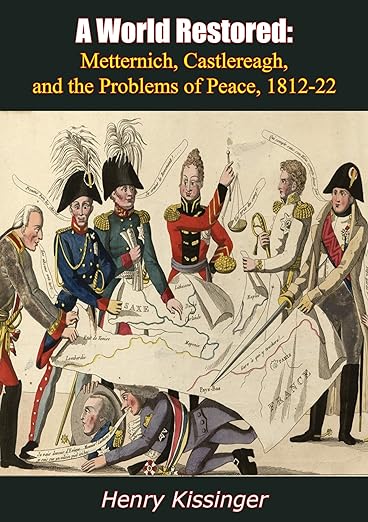
In A World Restored: Metternich, Castlereagh and the Problems of Peace 1812-1822. Kissinger writes a handbook for how a realist statesman should construct a stable and enduring balance of power. The book was published in 1957 and evolved out of Kissinger’s doctoral dissertation at Harvard. Austrian chancellor Klemens von Metternich used the real politik tool of raison d’état to build in post-Napoleon Europe a stable balance of power, the highest level of international stability in the Kissinger world view. (One can also see in this book the origins of Kissinger’s effusive portrait of Richelieu later painted in Diplomacy.) To oversimplify, Kissinger divides his history into three phases: (1) the formation of the Coalition and defeat of Napoleon, (2) the Congress of Vienna, and (3) the aftermath of maintaining the balance of power. The conference system embodied in the Congress of Vienna and its successor conferences was the earliest attempt at European-wide government; the experience is pregnant with lesson for today’s world of multilateral governance. Such a movement inevitably moves towards being more representative because order is legitimized through consent.
When order is imposed from top down, an autocracy of some type is presupposed. This can come in two forms: a conservative structure represented by a cluster of monarchies (the old order)—the world being restored in Kissinger’s title—or the radical autocracy of the modern ideological dictator that seeks to dominate everyone within its sphere of interest. Kissinger saw Napoleon as a new-style autocrat, a radical product of revolution, trying to overthrow the rough equilibrium of the stable monarchical world order of 18th century Europe. French kings had traditionally strove to create a system of European-wide stability hospitable to French interests by preventing a concentration of power in any one country east of the Rhine River. In contrast, Napoleon had gone all-conqueringly universal and gambled on projecting power to establish French dominance over all of continental Europe, or establishing universal dominion in Kissinger’s terms. Metternich saw that Napoleon’s Empire was incompatible with a system of equilibrium.
Metternich, an Austrian minister, successfully manipulated European power politics through his masterful management of the British option where Britain was the offshore financial and maritime power complementing continental land power. Lord Castlereagh, the British foreign secretary, identified British security with continental stability and was alive to the threat of universal dominion controlling continental Europe. However, with the end of the Napoleonic wars, Britain became much less sensitive to smaller conflicts across Eurasia, much like modern America which is sensitive to threats of universal dominion but willing to fellow-travel with all sorts of other local rogues to keep regional balances of power well balanced in its overall favor.
Napoleon was a new kind of autocrat, a product of revolutionary conditions that spawn exceptionally disruptive leaders. These adversaries must be managed carefully; they are not “just like us.” For example the leaders of revolutionary Iran are distinctively different than the more staid leaders of the monarchical Gulf States and Saudi Arabia. Iran aims to overthrow; the Arab monarchies to preserve. The Iran regime is radical; the Gulf Arabs conservative. Something similar obtained at the dawn of the nineteenth century; Napoleon aimed to overthrow the monarchial order of Europe and replace it with a more centralized imperial regime. Kissinger writes: “Whenever peace—conceived as the avoidance of war—has been the primary objective of a power or a group of powers, the international system has been at the mercy of the most ruthless member of the international community.” Kissinger saw clearly the ruthlessness in the autocrats; they are not “just like us.” When engaging with autocrats, Kissinger was careful not to show weakness; therefore there were lots of displays of state violence which gave his diplomacy the credibility of force that would be used. He would and did pull the trigger. Red lines were defended. Nixon was “tough,”
After the defeat of the disruptive autocrat Napoleon, Metternich midwifed the Congress of Vienna, which created the scaffolding for a century of peace based on a balance of power within Europe. Where the British public and cabinet wanted a harsh peace imposed on defeated France, it was “Castlereagh who brought about a peace of equilibrium and not vengeance, a reconciled and not an impotent France.” This was one of the fatal errors of the Versailles Peace Treaty negotiated a century later and whose defects were so accurately identified by John Maynard Keynes in his classic The Economic Consequences of the Peace. Castlereagh recognized that integration must take precedence over retribution in the construction of a renewed legitimate order. Reconciliation, not triumph, is the key to future equilibrium. The long peace was overthrown early in the twentieth century as a result of the European nations aligning themselves into two brittle blocs of allied nations that daisy-chained themselves together with interlocking security guarantees. When Austria set-off the blasting cap with its declaration of war and initiation of hostilities against Serbia on July 28, 1914, the alliances then crackled like firecrackers into a rapid-fire escalation of hostilities into the general conflagration of the Guns of August of 1914.
Returning to World Restored, British foreign secretary Lord Castlereagh is in the title because his exit as British foreign secretary resulted in Britain leaving the continental arrangement of periodic congresses used to maintain the balance of power. The European powers settled into what now became the less stable Holy Alliance of Austria, Prussia, and Russia, termed the Eastern Powers. They were missing the offshore balancer, Great Britain, which had exited continental governance (presaging the 2016 Brexit from the European Union and confirming Charles de Gaulle’s veto message of Britain’s original application to the EU where one reason given was that Britain always thought of itself as being an island).
Two world wars and one extended Cold War later, the force-like perception of the benefits of European confederation if not federation has resulted in a Europe today that has organized most European states into one political union, the European Union. This union is concurrently organized into one defensive alliance, Nato, which is in a faceoff between democratic Europe and the autocratic Eurasian power of Russia under the dictator Vladimir Putin. One might also observe that all the lands east of the Dnieper River and north of the Himalayas are autocratic, a very large space which confounds the belief in the inevitability of liberal democracy. One might also say that an understanding of modern Europe begins with an understanding of the international politics discussed in A World Restored.
Kissinger used the metaphor of the Conqueror and the Prophet to symbolize the motivating forces behind attacks on the legitimate order. The Conqueror represents the quest for universality while the Prophet embodies the yearnings for eternity. Napoleon had shown that autocratic power was not self-limiting; the world’s experience with Conqueror across the ages has proved that they do not self-limit. In modern life, the shorthand for this is the Munich analogy. Stability in an international order depends upon self-limitation.
As to the Prophet, one sees that radicalized Islam is revolutionary and disrupts societies both within the traditional lands of Muslim rule and now in once-Christian lands where many Muslim immigrants have settled. Both autocracy and religious movements feature incandescent personalities who light up the message with the charisma of their personalities. Kissinger notes that the charismatic appeal of the revolutionary is legitimized by either his person or his principle. The revolutionary exhorts the masses by either holding up a book or pounding on his own chest (“Only I can do it!”)
National achievement is ultimately dependent upon national political objectives and these are defined outside the sphere of diplomacy and which diplomats within a country must treat as given. Diplomacy is a tool.
Some choice lines in the concluding chapter are:
• It is thus that the gods revenge themselves by fulfilling our wishes too completely.
• Perfection implies uniformity.
• The statesman … must be prepared for the worst contingency.
• That it is not balance which inspires men but universality, not security but immortality.
• Inspiration is a call for greatness; organization a recognition that mediocrity is the usual pattern of leadership.
Kissinger outlines views on statesmen and statesmanship, the political captain steering the diplomatic ship. There is the difficulty of action because of the limitation of knowledge, of being confronted with material circumstances which must be treated as given, the geography and availability of resources which circumscribe action. The test of a statesman becomes his ability to recognize the real relationship of forces, which might be obscure, and to make this insight serve his ends. But the acid test is the ability to obtain domestic support for diplomatically achieved agreements, the great failure of President Wilson with the Versailles Peace Treaty in the US Senate in 1920.
Summing up Metternich, Kissinger noted his uncanny faculty of achieving personal dominance over his adversaries. One is reminded of the American über-diplomat Richard Holbrooke in this regard who brought great force of personality to personal negotiations with some pretty tough characters.
Kissinger makes the point that a people may be aware of the consequences of a revolutionary situation in general but if they cannot specifically identify a revolution in its immediate prospect as it approaches—for instance in a coming election—then this is an empty form of knowledge. The people get overthrown before they can counteract. One wonders about this disturbing prospect when large numbers of Americans do not seem to recognize the revolutionary potential in reelecting Donald Trump in 2024. A second Trump term would unlikely be routine governance but rather a series of revolutionary challenges, each more dire than the previous.
Returning to the world of classical international relations, Kissinger concludes with a succinct summation of his view of statesmanship:
It is not surprising that Castlereagh and Metternich were statesmen of the equilibrium, seeking security in a balance of forces. Their goal was stability, not perfection, and the balance of power is the classic expression of the lesson of history that no order is safe without physical safeguards against aggression.
.
Kissinger had a molecular understanding of European international relations since the 16th century and a wide-ranging understanding of the evolution of global history that has brought global society to the world of today. So in conclusion we see a historical progression of three brilliant internationalist statesmen—the realist trinity of Richelieu, Metternich, and Kissinger—whose thinking has constructed the modern edifice of modern international relations. Of the three titans, all of whom have on themselves the dirty hands of high politics, Metternich is probably the cleanest dirty shirt among the bunch.
All rights reserved by Paul A. Myers, 2024.
 Myersbooks History