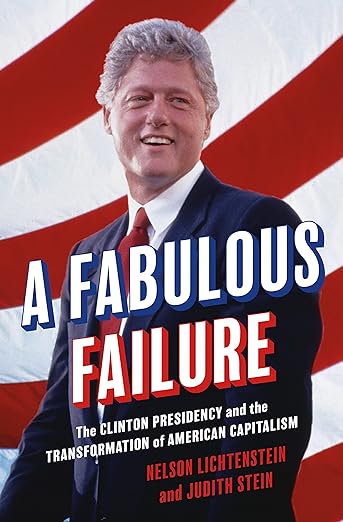
BOOK REVIEW
A Fabulous Failure: The Clinton Presidency and the Transformation of American Capitalism
By Nelson Lichtenstein and Judith Stein
Princeton University Press, Princeton and Oxford, 2023
Book Review by Paul A. Myers
Today’s Democratic party politics embodied in the Biden administration are a concatenation and extension of policies and politics of the predecessor Clinton and Obama administrations not least because the same people have populated all three administrations. Knowing about previous policy debates and achievements and failures provides a window into today’s fractious present.
A Fabulous Failure does a marvelous job delivering on both policy and politics in a highly readable narrative.
Early coverage of the Clinton presidency revealed the hard structures of American capitalism in an economy undergoing profound change in response to the immense forces termed “globalization.” The political terrain facing the new Clinton administration resembled the conflicts and compromises that had reconfigured the American economy during the early years of the New Deal sixty years before. But reform foundered in the 1990s.
Why did the Clinton effort prove a failure? The answers help explain the consequences that are with us to this day. The Clinton story also suggests why the Obama administration accomplished less than it might have considering the magnitude of the 2008 financial crisis. There was a Great Depression-sized economic shock but no New Deal political transformation afterwards—some reform but not social democratic transformation.
It is a story of labor and capital, the study of political economy, and capitalist transformation—another chapter in the “creative gales of destruction” which periodically sweep across the economy. The contradictory nature of US trade policy during this era embodied these contradictions—how to globalize while protecting domestic working-class wages and standards of living while riding trade liberalization with its generalized and overall beneficial lifting of living standards.
Central to the failure of any lasting Clinton legacy was the collapse of the Clinton Health Security Act; government was not made to work for the people through a major expansion of a socially insured benefit central to people’s personal well-being. Health care—the great unfinished work of the Democratic party in the twentieth century—continued uncompleted. Later, the deregulation of banking and telecommunications cast a neoliberal pall over the Clinton era; the deregulation was remembered, the memory of its benefits faded. What had happened? Thwarted progressive politics interacted with misguided efforts to find market solutions to difficult social problems characterized a politics that never quite worked for the people but worked marvelously for Wall Street.
At the beginning of the Clinton era, the management reform of American capitalism stood at the top of the agenda. First was the universalization of health care. The second thrust was to manage trade, as had Reagan with Japanese automakers.
Health care and its dysfunctional payoffs and incomplete coverage had so many solutions that it was difficult to meld them into one saleable package. The issue was perceived as urgent. Health care was a rapidly escalating cost in relation to corporate payrolls. A pay-or-play payroll tax was a central option considered. Opportunities presented by managed care were explored. This would be domestic legislation on an epic scale.
A full explication of the complexities of the sprawling American health care system is provided. These issues continued through the Obama Affordable Care Act to the present day with liberal dissatisfactions expressed under the rubric “Medicare for All” and Republican reactionary resistance under the chant of “Repeal Obamacare.” Lessons learned from the defeat of Clinton health care effort provided a political base of lessons learned for the successful passing of the Affordable Care Act in the Obama presidency. The political landscape had changed and new things were possible fifteen years later.
Then and now, foreign trade was a divisive issue for Democrats and a major concern with voters. In the Clinton years it was developing economy mercantilism by Japan while trade agreement controversies swirled around NAFTA, the gigantic trade pact with Mexico and Canada. At a basic level, this is free-trade capitalism versus managed capitalism by more centralized or authoritarian states (“unfair competition”). Most international competition is “unfair” because nations exploit deep cleavages in comparative advantages between nations and economies, a continuous feature of often harsh international economic competition.
The Clinton administration had a full stable of market friendly economic advisers in key policy areas led by Robert Rubin and Larry Summers at the Treasury. A key assertion made in this book was that these two individuals championed the creation and furtherance of the vast and unregulated financial derivatives market which was the rocket fuel leading to the conflagration of the 2008 financial crisis, which was bigger than just home foreclosures and weakly capitalized banks. (Bank capital was not impaired; it was annihilated.) This leads to the intriguing question: was the financial crisis a result of lax Bush administration regulation or malignant design by Clinton administration architects?
At the center of the economic deregulation debate was the Rubin-Summers advocacy of the repeal of the Glass-Steagall prohibition of combining commercial banking and investment banking in one corporate entity. The ruthless segregation of the two activities had been a key architectural achievement of Roosevelt’s New Deal. Clinton repeal of Glass-Steagall permitted the concentration of vast financial power in very large financial super-banks to go along with the vast concentration of wealth in the hands of the super-rich enabled by the Bush administration tax cuts on capital gains and dividends in the early 2000s.
But the book goes on to show that maintaining derivatives outside the purview of federal financial regulation was the big destabilizing force that led to the 2008 financial crisis being so much larger than any other postwar financial crisis. The derivatives rocket fuel exploded the entire economy.
The book is clear and devastating in its depiction of how financial policy in the United States was changed and deregulated in the Clinton era. This neoliberal revolution continued into the Obama administration where Democratic party neoliberalism reached an apotheosis of finance-friendly reform. The Obama administration was almost an antithesis of the policy posture of the New Deal three generations before. Wall Street was nurtured, not reformed—and not least because finance-centered wealth concentration enjoyed support in both political parties. The success of the New Deal was a product of the deepest economic crisis in the nation’s history intersecting with the most skilled political reformer to be president since Abraham Lincoln. Lincoln had had a strong domestic program in addition to winning the Civil War. The Democratic party has not approached the leadership heights reached by Franklin D. Roosevelt since.
The book concludes with a powerful epilogue. Why didn’t the Clinton peace and prosperity carry over to the new century? Two arguments are advanced. First, setting aside the argument that Al Gore’s defeat came from his boring personality, the book points out that trade deals permanently alienated the working-class voters first attracted to Ross Perot’s presidency. The second was that Gore’s promise to “lock box” vast federal surpluses offered the Democratic base no new benefits. A basic test of “what is in it for us” was flunked. These voters began a long odyssey to the right that has taken many of them far over to the radical right wing as discontent curdled and tens of millions felt themselves estranged from the Washington establishment. The conclusion was that the Clintonistas got both the economics and the politics wrong.
The epilogue describes massive economic intervention in 2020 with the $2.2 trillion bipartisan CARES act, a big omnibus spending bill. The new Biden administration followed with a $1.9 trillion Build Back Better omnibus bill followed by a trillion-dollar infrastructure bill—the first in over a generation—and the CHIPS act, a half industrial policy and half infrastructure bill. This has put growth impetus and momentum into the American economy—but will it be enough to secure electoral victory in 2024?
Reform? Various Biden appointees and agencies have taken a more aggressive stance towards industrial concentration through antitrust and similar regulatory initiatives, but the Congress has resolutely refused to tackle extreme wealth concentration among the superrich, its most reliable founding source. Can industrial concentration be addressed without addressing the concentrated wealth of the patrons? Considering that the 2024 elections will be won up and down the line by beneficiaries of campaign contributions from the superrich, it is unlikely that a fresh New Deal awaits in 2025.
 Myersbooks History